

When hazardous materials teams respond to an unknown environment, their first priority is clear: obtain atmospheric readings before committing personnel into the hazard area. The Sensor Mule HAZMAT sensor deployment robot allows teams to remotely deploy the handheld detectors they already trust while maintaining a safe standoff distance.
Instead of replacing existing detection equipment, the Sensor Mule extends the reach of today’s multi-gas meters, radiation detectors, and chemical monitoring instruments—reducing responder exposure while improving operational awareness during the earliest stages of an incident.
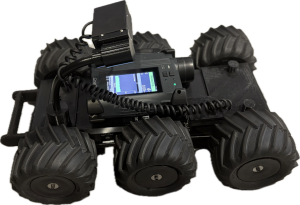
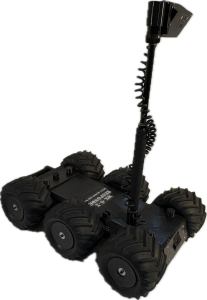
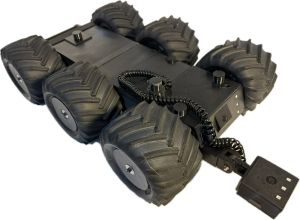
Deploy Any Handheld HAZMAT Sensor from a Safe Standoff Distance
Most HAZMAT teams already carry reliable handheld detection tools. The challenge is safely placing those instruments where readings are needed.
The Sensor Mule enables responders to:
- deploy multi-gas detectors into hazardous atmospheres
- position radiation sensors near suspicious sources
- place meters inside railcars, vehicles, or confined spaces
- monitor unknown vapor clouds from a distance
- remotely read instrument displays without wireless connectivity
- perform atmospheric monitoring before personnel advance
This transforms standard handheld meters into remote monitoring tools without changing equipment or procedures.
Purpose-Built for Remote Atmospheric Monitoring Operations
The Sensor Mule was designed specifically as a remote sensor deployment robot for HAZMAT response, not as a general-purpose robotics platform.
Its six independently driven wheels provide stable movement across:
- industrial flooring
- rail ballast
- debris fields
- transit infrastructure
- warehouse environments
- uneven outdoor terrain
Because the platform is optimized for transporting sensors rather than manipulation arms, it remains compact, lightweight, and fast to deploy from first-arriving apparatus.
This makes it ideal for:
- unknown substance investigations
- chlorine or ammonia leak response
- rail and transit incidents
- confined space monitoring
- suspicious package screening
- industrial spill response
- pre-entry atmospheric assessment
Early readings support faster and safer decision-making.
FlexView Sensor Camera Enables Remote Meter Display Monitoring
Many handheld detection instruments still rely on onboard displays instead of wireless telemetry. The FlexView Sensor Camera solves this limitation by allowing operators to remotely observe sensor readings in real time.
Mounted on a positionable coiled tether, the FlexView Sensor Camera allows teams to:
- read detector displays from a safe distance
- monitor alarm conditions remotely
- elevate the camera for improved visibility
- inspect under vehicles and equipment
- observe obstructed or confined spaces
This ensures compatibility with virtually any handheld HAZMAT sensor used today, including models without connectivity.
Elevated and Under-Vehicle Inspection Capability
Situational awareness during hazardous materials incidents often requires visibility beyond ground level. The FlexView Sensor Camera can be positioned for elevated observation or directed upward for under-vehicle inspection during suspicious package investigations and infrastructure response scenarios.
This adds reconnaissance capability without introducing additional equipment.
Designed for First-Arriving Units
During hazardous materials incidents, the first readings often determine the entire response strategy. The Sensor Mule allows atmospheric monitoring to begin immediately, without waiting for specialized robotics teams to arrive.
This capability is especially valuable during:
- tanker incidents
- warehouse alarms
- rail emergencies
- unknown vapor releases
- suspicious containers
- transportation infrastructure events
Earlier information supports safer scene control and faster hazard assessment.
Extending the Capability of Existing Detection Equipment
The Sensor Mule increases the effectiveness of the detectors teams already carry by allowing them to operate inside potentially dangerous environments while personnel remain at a safer distance.
This improves:
- responder safety
- incident assessment speed
- operational flexibility
- confined space monitoring capability
- compliance with exposure-reduction best practices without requiring additional sensor purchases or retraining.
A Practical Robot for Modern HAZMAT Response Teams
Robotic platforms designed specifically for atmospheric monitoring and sensor placement remain uncommon. The Sensor Mule fills that gap by giving teams a simple and reliable way to deploy detection equipment remotely and gather critical information before committing personnel.
It provides what HAZMAT teams need most, remote atmospheric monitoring from a safe standoff distance while supporting the instruments they already rely on.
Contact Innvotronics to schedule a demonstration of the Sensor Mule HAZMAT sensor deployment robot and expand your team’s remote monitoring capability while reducing personnel exposure risk.
Innvotronics’ Innovative Line of Throwable Tactical Robots
 Innvotronics has redefined the concept of throwable tactical robots with its MK-2 Under Door Camera Robot. This device slips under doors to provide discreet surveillance, capturing real-time footage without alerting occupants.
MK-4 Four-Wheel Drive Tactical Robot
 The MK-4 Four-Wheel Drive Tactical Robot offers exceptional mobility across diverse terrains. Its rugged design and four-wheel-drive system allows it to navigate obstacles and deliver vital information from the field.
 The MK-8 Stair Climbing Robot tackles vertical challenges with ease. Its advanced locomotion system enables it to ascend stairs and surmount obstacles, expanding the operational reach of tactical teams.
Ready to elevate your tactical operations to the next level? Contact us today by visiting our website or call 516 456-0200 to receive more information on any of our tactical robots, including the MK-2 Under Door Camera Robot, MK-4 Four-Wheel Drive Robot, and MK-8 Stair Climbing Robot. Experience firsthand how Innvotronics‘ innovative solutions can enhance your mission effectiveness and safety.


